On This Page
DeepSeek DSpark: What Semi-Autoregressive Speculative Decoding Actually Changes
DeepSeek DSpark adds semi-autoregressive drafting and load-aware verification to speculative decoding. What is new versus EAGLE-3, and why the benchmarks are not yet independently verified.

On June 27, 2026, DeepSeek released DSpark, a new speculative decoding drafter for DeepSeek-V4, alongside DeepSpec, an MIT-licensed codebase for training and evaluating draft models on open models like Qwen3 and Gemma. The headline claim is that DeepSeek DSpark makes per-user generation 60-85% faster than the MTP-1 baseline already running in production. That is a large number, and the first thing worth saying about it is that DeepSeek measured it on DeepSeek's own serving system, with DeepSeek's own checkpoints. No third party has reproduced it yet.
So the useful question is not "is it fast" but "what did they actually change, and is it a new idea or a faster repackaging of the drafters we already have." Having pulled apart the release, the answer is that DSpark introduces two mechanisms that genuinely move past EAGLE-3, the drafter most teams reach for today. This piece assumes you already know how speculative decoding works; if you do not, the speculative decoding tutorial covers the draft-verify loop, the lossless guarantee, and the batch-size catch that turns out to be central here. The focus below is on what is new in DSpark and how much of the claimed speedup you should believe before you measure it yourself.
What DSpark is, and what baseline it beats
DSpark is a drafter, not a new model. The released checkpoints, DeepSeek-V4-Pro-DSpark and DeepSeek-V4-Flash-DSpark, reuse the existing V4 weights and attach a small draft module on top. Output stays lossless: like all correct speculative decoding, the verification step preserves the target model's exact output distribution, so the text you get is identical to running V4 with no drafter at all. The speedup is pure serving efficiency, not a quality tradeoff.
The baseline matters more than it first appears. DSpark is measured against MTP-1, not against plain autoregressive decoding. Multi-Token Prediction is the speculative scheme DeepSeek built into V3 and carried into V4: the model is trained with extra heads that predict more than one token ahead, and at inference those predictions seed a draft that the main model verifies. MTP-1 means using that mechanism at depth one, a single extra predicted token. So "60-85% faster than MTP-1" is an improvement over an already-accelerated production baseline, not over a naive decoder. That cuts both ways. It makes the gain more credible as a real serving delta DeepSeek saw in production, and it means the raw multiple over unaccelerated decoding is larger than 60-85%, but you cannot back it out from the released numbers because the MTP-1 baseline is itself undisclosed in absolute terms.
Novelty 1: semi-autoregressive drafting
The core architectural idea is a middle path between the two drafting styles that dominate today, and it targets a specific failure mode of each.
Lay out the existing options. A sequential drafter like EAGLE-3 predicts each draft token conditioned on the previous one. That conditioning is what makes its drafts accurate deep into a span, but it serializes drafting: producing k tokens means k small sequential steps. A fully parallel drafter, the approach DeepSeek calls DFlash, predicts all k positions at once from the target's features. That is fast, but acceptance decays along the span, because the later positions are guessed without knowing what was chosen for the earlier ones, and a draft that goes wrong at position two wastes positions three through k.
DSpark splits drafting into two stages to get most of both. A parallel backbone first produces base logits for every draft position simultaneously, the fast part. Then a lightweight sequential head adds a prefix-dependent correction before sampling each token. The released coverage describes this head as a low-rank, Markov-style component (a rank-256 factorization in the secondary writeups) that looks only at the immediately preceding token rather than the full prefix. That is the design trick: a full autoregressive head is expensive because each token waits on a complete forward pass over everything before it, while a head that conditions on just the last token is cheap to evaluate yet still breaks the independence assumption that makes pure-parallel drafts decay. You pay a little sequential cost to stop the acceptance collapse.
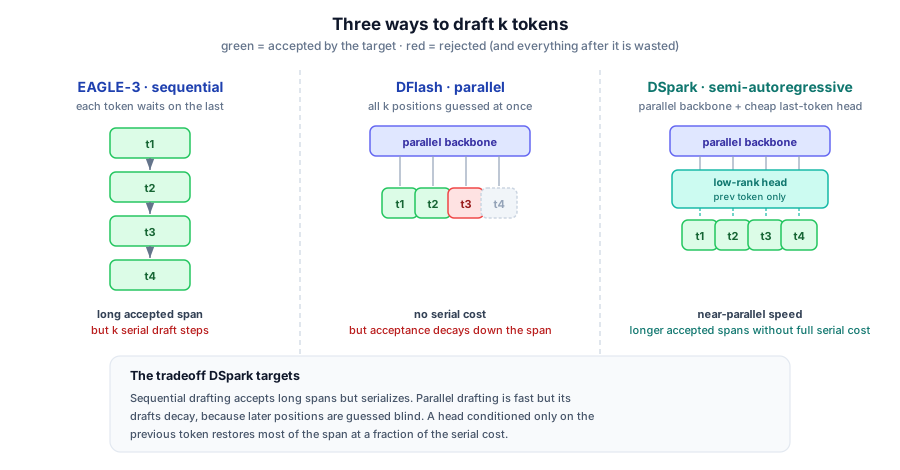
The reported payoff is in acceptance length, the average number of tokens accepted per verification pass, which is the direct driver of speculative speedup. DeepSeek reports DSpark improving average acceptance length over EAGLE-3 by 26.7% to 30.9% on Qwen3 models at 4B, 8B, and 14B, and over DFlash by 16.3% to 18.4%. Higher acceptance length with a cheap-to-run draft head is exactly the combination that should translate into wall-clock gains, which is the claim the production numbers are meant to back.
Novelty 2: load-aware verification
The second mechanism is the one that should interest anyone who has actually deployed speculative decoding, because it engages head-on with the single biggest caveat of the technique.
Recall the batch-size catch from the speculative decoding tutorial: speculation spends spare compute to skip memory reads, so its benefit collapses as concurrency rises and the GPU becomes compute-bound. At batch size one you have abundant idle compute and speculation is a clear win. On a server saturated with concurrent requests, the extra verification work competes for compute that is already busy, and the speedup trends toward zero or negative. Most drafters treat this as a fixed property: you verify a configured number of tokens regardless of how loaded the server is.
DSpark makes the verification budget adaptive. A confidence head outputs a per-position score estimating how likely each drafted token is to survive verification. A hardware-aware prefix scheduler then sets the verification length per request based on live GPU utilization. When the system has spare compute, it verifies more tokens, riding longer drafts. When concurrency is high and the GPUs are under pressure, it verifies fewer, spending less compute on speculation precisely when speculation pays least. This is a direct, designed-in answer to the batch-size catch rather than a property you discover after the fact. It is also why the production claim is framed as a per-user speedup "at matched throughput": the scheduler is trying to buy latency for individual users without sacrificing aggregate tokens-per-second, which is the regime where naive speculation usually forces a choice.
Whether it fully escapes the catch is exactly the kind of claim that needs independent measurement. A scheduler that backs off under load by definition gives back some of its speedup under load. The honest reading is that DSpark converts a hard cliff into a graceful curve, not that it makes speculation free at high concurrency. That distinction only shows up if you measure at your real concurrency, the same discipline the original technique already demanded.
The numbers are vendor-provided, and that is the whole caveat
Every figure in this release comes from DeepSeek: the 60-85% per-user speedup on Flash, the 57-78% on Pro, the acceptance-length gains over EAGLE-3 and DFlash. They are drawn from DeepSeek's own paper, their released checkpoints, and their own production serving metrics. As of this writing no independent party has reproduced them. That does not make them wrong. It makes them unverified, which is a different thing, and the distinction is the entire point of treating a benchmark as a hypothesis rather than a result.
There are concrete reasons to keep the skepticism specific rather than reflexive. First, the baseline is MTP-1, a DeepSeek-internal system, so the comparison is fair only to the extent that MTP-1 was tuned as hard as DSpark, and you cannot check that from outside. Second, the production speedups are reported on V4-Flash and V4-Pro on DeepSeek's infrastructure, so the acceptance rates reflect DeepSeek's traffic mix, which has its own distribution of code, chat, and structured output, and acceptance length is workload-dependent. Third, "at matched throughput" is doing real work in the framing: a per-user latency win at constant throughput is the genuinely hard result, but it also means the number is a point on a load curve, not a single scalar you can port to your own server. This is the same reason the LLM evaluation crisis argues against trusting any single score detached from its baseline and its distribution.
The mitigating factor, and it is a real one, is that DeepSeek open-sourced the means to check most of this. DeepSpec ships the DSpark, DFlash, and EAGLE-3 algorithms with a full data-prep, training, and evaluation pipeline under an MIT license, with released draft checkpoints for Qwen3 (4B, 8B, 14B) and Gemma. The evaluation suite spans GSM8K, MATH-500, AIME 2025, HumanEval, MBPP, LiveCodeBench, MT-Bench, AlpacaEval, and Arena-Hard. So the acceptance-length comparison against EAGLE-3 and DFlash on open models is reproducible by anyone with the hardware, even though the V4 production speedup is not, because V4-scale serving is not something you can stand up at home. This is the open-weights pattern DeepSeek has made a habit of, the same one behind its V4 attention research: ship the design with code and weights attached, so the claims are at least checkable on the open-model slice.
Who should actually care
DSpark is not a thing most teams adopt directly, because most teams are not serving DeepSeek-V4 at scale. Its practical relevance splits in two.
If you serve V4, the DSpark checkpoints are a near-free upgrade over the MTP drafter you are already running, lossless by construction, and worth turning on and measuring against your own traffic at your own concurrency. The number to watch is acceptance length in your serving logs, not DeepSeek's production figure.
If you serve anything else, the interesting artifact is DeepSpec, not the V4 checkpoints. The semi-autoregressive draft head and the confidence-scheduled verification are general techniques, and the codebase lets you train a DSpark-style drafter for Qwen3 or Gemma and compare it head-to-head against an EAGLE-3 head on the same target, on your own eval set. That is the honest way to find out whether the acceptance-length advantage holds on your workload rather than DeepSeek's. The broader inference optimization stack is where a drafter choice slots in alongside quantization, KV-cache management, and batching, none of which DSpark changes.
The bottom line: DSpark is a real step past EAGLE-3, not a relabeling. Semi-autoregressive drafting attacks acceptance decay with a cheaper conditioning trick, and load-aware verification is the first drafter to treat the batch-size cliff as something to schedule around rather than suffer. Both are genuine contributions. The 60-85% figure is also genuinely DeepSeek's, measured in DeepSeek's regime, and until someone outside reproduces it on a comparable system, that is precisely how much weight it should carry.
Key Takeaways
- DSpark is a drafter, not a model. It reuses DeepSeek-V4 weights with an attached draft module and is lossless: output is identical in distribution to V4 with no speculation. The win is serving efficiency only.
- The baseline is MTP-1, not naive decoding. The claimed 60-85% (Flash) and 57-78% (Pro) per-user speedups are over DeepSeek's existing Multi-Token Prediction drafter, an already-accelerated production baseline, which makes the delta both more credible and harder to translate to absolute terms.
- Semi-autoregressive drafting is the first real idea. A parallel backbone proposes all positions at once, then a cheap sequential head conditioned only on the previous token adds a correction, splitting the difference between EAGLE-3 (accurate but serial) and fully parallel drafting (fast but decaying).
- Load-aware verification is the second. A confidence head plus a hardware-aware scheduler set verification depth per request from live GPU utilization, directly targeting the batch-size catch that makes speculative decoding collapse at high concurrency.
- The acceptance-length gains are the mechanistic claim. DeepSeek reports +26.7-30.9% acceptance length over EAGLE-3 and +16.3-18.4% over DFlash on Qwen3 4B/8B/14B. Acceptance length is the direct driver of speculative speedup.
- All numbers are vendor-provided and unverified. Every figure comes from DeepSeek's paper, checkpoints, and production metrics; no independent reproduction exists yet. Treat them as a hypothesis tied to DeepSeek's baseline, infrastructure, and traffic mix.
- DeepSpec makes the open-model slice checkable. The MIT-licensed codebase ships DSpark, DFlash, and EAGLE-3 with training and eval pipelines for Qwen3 and Gemma, so the acceptance-length comparison is reproducible even though the V4-scale production speedup is not.
- Measure at your concurrency. If you serve V4, turn DSpark on and watch acceptance length in your own logs. If you serve anything else, train a DSpark-style drafter with DeepSpec and compare it to EAGLE-3 on your workload, not DeepSeek's.
The Acing AI newsletter takes apart inference releases the way this piece takes apart DSpark: what the mechanism actually is, and how much of the vendor's number survives contact with your own serving regime. Subscribe if that is your kind of detail.
Was this useful?
Quick, anonymous, no strings.


