On This Page
Your LLM Serving Bottleneck Moved to the CPU
vLLM v0.27.0 and SGLang v0.5.17 rewrote their serving frontends in Rust. The real LLM serving bottleneck is often the CPU-bound Python frontend, not the GPU.

You provisioned GPUs for an LLM serving deployment, warmed the prefix cache, and the throughput plateaued below what the accelerators should deliver. You added GPUs and the ceiling barely moved. The instinct is to blame the model, the batch size, or the attention kernel. In a growing number of deployments the real LLM serving bottleneck is none of those. It is a single Python process parsing HTTP, tokenizing strings, routing requests, and streaming tokens back out, and it is pegged at 100% of one core while the GPU idles waiting for work.
That diagnosis stopped being a hunch in the second week of August 2026, when both dominant open serving stacks shipped the same fix within days of each other. vLLM v0.27.0 (2026-08-10) landed a Rust frontend as a drop in alternative to its Python API server, gated behind VLLM_USE_RUST_FRONTEND=1. SGLang v0.5.17 shipped initial support for a Rust frontend the same week, migrating everything from network ingress up to the point a tokenized request reaches the GPU scheduler out of Python and into multi threaded Rust. Two independent teams, converging on the same target in the same seven days, is not a coincidence. It is a measurement.
The bottleneck was hiding on the CPU
The number that did not fit the story
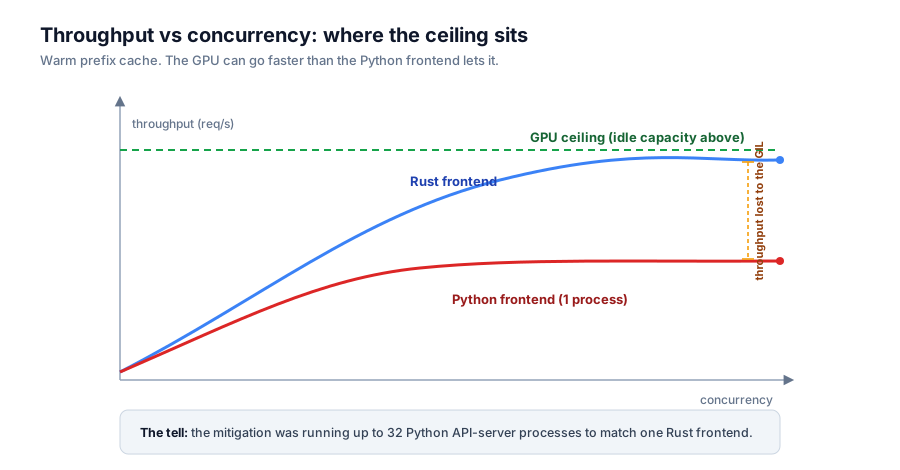
The tell was a workaround that everyone running vLLM at scale already knew: to get throughput up, you ran more API server processes. Not more GPU workers, more frontends. The vLLM RFC that motivated the Rust rewrite (issue #40846) is blunt about how far this had to go. On a preprocessing heavy workload, a single default Python frontend served 162 requests per second. Matching one Rust frontend required 32 Python API server processes to reach 785 requests per second.
Read that again. The mitigation for a slow frontend was to run 32 copies of it. When the fix for a component is to horizontally scale it 32 times inside a single node, that component is not a detail. It is the bottleneck wearing a disguise, and the disguise is that it lives on the CPU where nobody was looking, because everything about LLM serving has trained you to look at the GPU.
The RFC's headline numbers, all measured on Qwen3-0.6B across 4x GB200 at concurrency 1024, split into two regimes:
| Workload | Configuration | Throughput | P50 TTFT |
|---|---|---|---|
| Decode heavy | Rust frontend | 559.79 req/s | 50.51 ms |
| Decode heavy | 4 Python processes (default) | 509.56 req/s | 165.95 ms |
| Decode heavy | 16 Python processes | 521.80 req/s | n/a |
| Preprocess heavy | 1 Rust frontend | 837.00 req/s | 596.92 ms |
| Preprocess heavy | 32 Python processes | 785.98 req/s | 657.15 ms |
| Preprocess heavy | 4 Python processes (default) | 162.23 req/s | 6076.09 ms |
The decode heavy row is the one to sit with. Rust is 10% ahead on throughput, which is real but unremarkable. The interesting axis is latency: 50.51 ms versus 165.95 ms P50 time to first token, a 3.3x reduction, at the same throughput class. That gap is not the GPU doing anything different. The GPU ran the identical model. The 115 milliseconds that vanished were spent in the Python frontend: acquiring the GIL, bouncing through the asyncio event loop, allocating and copying request objects, serializing responses. Your TTFT budget contained a CPU term, and you were probably not measuring it.
What the frontend actually does
"Frontend" undersells it. The layer that both projects rewrote is the entire request path before the model runs, and every stage of it is CPU work that competes for the same interpreter:
- HTTP ingress and validation. Parse the request body, validate the OpenAI compatible schema, handle headers, manage the connection. High connection churn makes this expensive.
- Tokenization. Turn the prompt string into token IDs. This is pure CPU, it scales with prompt length, and it is exactly the work the "preprocess heavy" benchmark stresses.
- Routing and scheduling handoff. Decide which engine or worker gets the request, apply sampling parameters, hand the tokenized request to the GPU scheduler.
- Detokenization and streaming. As the GPU emits tokens, convert IDs back to text, apply stop strings, format server sent events, and push each chunk over the wire. In a streaming decode workload this fires once per output token, per concurrent request.
Under Python, all of this shares one interpreter lock. asyncio gives you concurrency, not parallelism: a single event loop thread interleaves thousands of coroutines but executes CPU bound work one instruction stream at a time. At concurrency 1024, the detokenize and stream step alone is thousands of small CPU tasks per decode step, all queued behind the same lock. The GPU can finish a decode step and have nowhere to put the result, because the one thread that formats and ships tokens is busy formatting and shipping the previous batch. Adding GPUs does not help. The frontend was never the GPU's problem to solve.
Running 32 processes was the industry's answer because multiple processes mean multiple interpreters mean multiple GILs. It worked, at the cost of 32x the memory for tokenizer state and request buffers, 32x the connection pools, and an inter process routing layer to fan requests across them. Rust removes the reason for the trick. One multi threaded Rust process parses, tokenizes, routes, and streams across real OS threads with no global lock, so a single frontend saturates what previously took a small fleet of Python workers.
The fix, and the number behind it
Two rewrites, one week
The specifics differ, and the convergence is the point.
vLLM's Rust frontend (RFC #40846, integration PR #40848, with a Rust implementation developed at Inferact/vllm-frontend-rs) is a drop in replacement for the Python API server process. It keeps the existing vllm serve entrypoint and the Python launcher that manages subprocesses, and swaps the API server itself. As of v0.27.0 it exposes a gRPC control plane with engine aware health reporting, abort control, and server, model, and KV event source discovery, with vllm bench serve gaining opt in Rust delegation. It is opt in by design (VLLM_USE_RUST_FRONTEND=1), and the project is tracking feature parity with the Python path as a roadmap item rather than claiming it as finished. That parity gap is the honest caveat: a drop in that does not yet do everything the incumbent does is a migration, not a flag flip, and you verify your endpoints work before you cut over.
SGLang's v0.5.17 migration draws the boundary in the same place: the front half of the server, from network ingress up to the tokenized request handed to the GPU scheduler, moves from Python to a multi threaded Rust implementation. It bundles a Rust tokenizer manager, ingress validation and egress, an OpenAI compatible API server, and prefill/decode disaggregation support, shipped as prebuilt release artifacts. Same seam, same motivation, independently reached.
When two competing systems with different codebases, different maintainers, and different design philosophies independently decide in the same week that the Python frontend is the thing to replace, the signal is stronger than either benchmark alone. Neither team is selling you a GPU. Both concluded the CPU was the ceiling.
Reading the benchmark versus grading it
Here is where the numbers demand a second look, because the benchmark model is Qwen3-0.6B, a 0.6 billion parameter micro model. Anyone who reads inference benchmarks carefully should feel a reflex twitch, and the reflex is correct in general and wrong here, and the difference is the whole lesson.
When vLLM removed PagedAttention in Model Runner V2, the +56% throughput headline was measured on this exact model, Qwen3-0.6B, and that was a thumb on the scale. A micro model has almost no GPU compute per step, so it maximizes the fraction of wall clock spent in fixed runner overhead, which flatters any runner side optimization and makes the improvement look far larger than it will be on a model anyone serves in production. The representative number there was a single digit percentage on a real model. The micro model was chosen to make a small win look big.
The frontend benchmark uses the same micro model for the opposite reason, and it is the right instrument. The claim under test is about the frontend, not the model. To isolate the CPU cost of parsing, tokenizing, routing, and streaming, you need the GPU to get out of the way, and a 0.6B model is precisely how you do that. On a 235B model the GPU work per step is so large that it hides the frontend entirely, and you would measure nothing about the layer you rewrote. Shrink the model until the GPU is trivially fast, and whatever is left capping throughput is the frontend. The micro model is not hiding the GPU's contribution to inflate a number. It is removing the GPU's contribution to expose a different one.
That is the difference between reading a benchmark and grading one. Reading it means noting the model is tiny and discounting the result. Grading it means asking what the experiment is trying to isolate, then checking whether the model choice serves that goal or subverts it. Same model, same lab family, opposite verdict, because the question changed. The honest reader does not have a rule that says "micro model means suspect." The honest reader has a question that says "suspect of what." A frontend benchmark on a 70B model would be the misleading one, because the GPU would swamp the very term you claim to measure.
The corollary for your own numbers: if you want to know whether your frontend is your bottleneck, do not benchmark it behind your largest model. Benchmark it behind your smallest one, or behind a mock engine that returns instantly, and watch what happens to TTFT and throughput as concurrency climbs. If both stacks flatten well below your GPU's theoretical ceiling, the ceiling is on the CPU.
Deciding whether it is your bottleneck
Turning this into a capacity plan
The practical consequence is that HTTP parsing, tokenization, routing, and streaming are now a capacity planning line item, not an implementation detail you inherit from the framework. Here is a procedure to find out whether the frontend is your constraint and what to do about it.
- Warm the prefix cache first. This whole class of problem only surfaces once the GPU is not doing redundant prefill. With a cold cache the GPU is the bottleneck and the frontend is invisible. Measure in the steady state you actually run in. See effective context length for why a warm cache changes which resource binds.
- Measure TTFT and inter token latency separately from throughput. A frontend bottleneck shows up as TTFT that rises with concurrency while GPU utilization sits below saturation. If
nvidia-smishows the GPU idling at high request rates, the work is queued somewhere upstream. - Watch a single frontend core. Pin the API server and watch per core CPU. One core at 100% while others idle is the GIL signature: concurrency without parallelism. That one saturated core is your real limit.
- Split preprocess heavy from decode heavy traffic. Long prompts with short outputs stress tokenization and prefill handoff (the "preprocess heavy" regime). Short prompts with long outputs stress detokenization and streaming (the "decode heavy" regime). They bottleneck in different parts of the frontend and respond differently to the fix.
- Try the Rust frontend behind a flag before you re architect. On vLLM, set
VLLM_USE_RUST_FRONTEND=1and re run step 2. On SGLang v0.5.17 or later, enable the Rust frontend path. If TTFT drops and throughput rises with no GPU change, you were CPU bound and now you are not. If nothing moves, your bottleneck is elsewhere and you just saved yourself a migration. - Verify feature parity for your endpoints. The Rust paths are new and explicitly tracking parity. Exercise your actual request shapes, sampling parameters, streaming format, and any structured output or tool calling you depend on, against the Rust frontend before you route production traffic to it.
- Recompute your process count. If you were running N Python API server processes purely to get throughput, the Rust frontend may let you drop to one, reclaiming the memory and connection overhead those extra processes cost. That reclaimed memory can go to KV cache. See KV cache engineering for where it is best spent.
Where it breaks
Three honest limits keep this from being a free win.
It only helps if you were CPU bound. For a large dense or MoE model at modest concurrency, the GPU is the ceiling and the frontend is noise. Rewriting it in Rust changes nothing you can measure. The benefit scales with concurrency and inversely with model size, which is exactly why the RFC benchmark used a micro model at concurrency 1024 to make the effect visible at all. Serving a 200B+ model at concurrency 32, you will likely see no difference, and that is the correct outcome, not a disappointment.
Parity is a work in progress. Both frontends are opt in and new. vLLM is tracking feature parity as an open roadmap, which means some capability you rely on may live only on the Python path today. This is a migration with a checklist, not a toggle. Treat "drop in" as an aspiration you verify, not a promise you trust.
The bottleneck moves, it does not vanish. Take the CPU frontend out of the critical path and the next constraint surfaces, whether that is inter node bandwidth for a model spanning GPUs, the scheduler, or genuinely the GPU. That is the normal shape of performance work, and it connects directly to the rest of the serving stack. The broader picture of where these constraints live is LLM inference optimization, and the class of GPU side bottleneck the frontend was hiding is covered in speculative decoding. The point of this rewrite is not that the CPU is now solved. It is that the CPU was ever the problem, and for a year the ecosystem was routing around it with 32 processes instead of naming it.
Key Takeaways
- In warm cache, high concurrency LLM serving, the bottleneck is frequently the CPU bound Python frontend (HTTP parse, tokenize, route, stream), not the GPU. Adding GPUs does not raise a frontend capped ceiling.
- vLLM v0.27.0 (2026-08-10,
VLLM_USE_RUST_FRONTEND=1) and SGLang v0.5.17 both rewrote their serving frontends in Rust the same week. Two independent teams hitting the same target in seven days is a measurement, not a trend. - The old workaround was the diagnosis: running up to 32 Python API server processes to match one Rust frontend meant the frontend was the real constraint, hidden on the CPU where GPU centric tooling never looked.
- vLLM's RFC #40846 numbers (Qwen3-0.6B, 4x GB200, concurrency 1024): decode heavy, Rust at 559.79 req/s and 50.51 ms P50 TTFT versus 4 Python processes at 509.56 req/s and 165.95 ms, a 3.3x latency cut; preprocess heavy, 1 Rust frontend at 837 req/s versus 32 Python processes at 785.98 req/s.
- The benchmark uses a 0.6B micro model, and here that is the correct instrument, not a thumb on the scale. To isolate frontend cost you must remove the GPU's contribution, and a tiny model does exactly that. The same model flattered a runner benchmark in Model Runner V2 because the question there was different. Grade the experiment by what it isolates, not by the size of the model.
- Python's GIL turns
asyncioconcurrency into single core execution for the CPU work in the frontend. At high concurrency the per token detokenize and stream step queues behind one lock while the GPU idles. Multi threaded Rust removes the lock, so one process replaces the fleet. - Diagnose before you migrate: warm the cache, measure TTFT and GPU utilization separately, watch for one frontend core pegged at 100%, then try the Rust frontend behind its flag. If TTFT drops with no GPU change, you were CPU bound.
- The Rust frontends are opt in and still tracking feature parity. Verify your endpoints, sampling parameters, streaming format, and structured output against the Rust path before routing production traffic. The benefit scales with concurrency and shrinks with model size, so a large model at modest concurrency sees nothing.
Was this useful?
Quick, anonymous, no strings.


